RAG for Internal Policy Interpretation & Decision Support

Turning Corporate Policies into a Conversational, Risk-Aware AI Assistant
Introduction: The Hidden Cost of “Policy Confusion”
Every mid-to-large organization has hundreds of internal policies—HR manuals, compliance rules, finance SOPs, IT security guidelines, legal playbooks.
Yet employees still ask questions like:
- “Can I approve this expense?”
- “Is this hiring exception allowed?”
- “What happens if we miss this compliance deadline?”
The usual answers:
- Search PDFs
- Ask HR or Legal
- Rely on tribal knowledge
- Guess (dangerous)
This leads to:
- ❌ Delays
- ❌ Wrong interpretations
- ❌ Compliance risk
- ❌ Overloaded HR & Legal teams
Retrieval-Augmented Generation (RAG) solves this problem in a way traditional search, chatbots, or fine-tuned models cannot.
Why This Use Case Is Trending — Yet Rarely Implemented
Trending Because:
- Enterprises want AI copilots, not chatbots
- Compliance pressure is increasing
- Employees expect “ChatGPT-like” answers internally
Rarely Implemented Because:
- Policies are messy, unstructured, and versioned
- Legal teams fear hallucinations
- Governance and access control are complex
- Most teams don’t understand grounded AI
This gap creates a massive opportunity.
The Core Problem with Traditional Approaches
1. Keyword Search (SharePoint / Drive)
- Returns documents, not answers
- No context awareness
- Employees still misinterpret policies
2. HR / Legal Helpdesks
- Slow
- Expensive
- Not scalable
3. Fine-Tuned LLMs
- Policies change frequently
- High retraining cost
- Risk of outdated answers
- Poor explainability
Why RAG Is the Right Architecture
RAG = LLM + Trusted Internal Knowledge
Instead of training the model on policies, RAG:
- Retrieves the most relevant policy sections
- Injects them into the prompt
- Generates answers only from approved sources
This means:
- ✅ No hallucinations
- ✅ Always up-to-date
- ✅ Explainable answers
- ✅ Audit-friendly
Real-World Corporate Use Case
Scenario: Expense Approval & HR Exceptions
An employee asks:
“Can I approve a ₹1.2L client dinner without VP approval?”
What the RAG System Does:
- Searches:
- Expense policy
- Approval matrix
- Region-specific rules
- Retrieves exact clauses
- Responds with:
- Yes/No
- Approval requirement
- Supporting policy references
Example Output:
“No. As per Expense Policy v3.2, Section 4.1, client entertainment above ₹1L requires VP approval. You may submit an exception request via HRMS.”
No guessing. No policy misuse.
RAG Architecture (Practical, Not Theoretical)
Data Sources
- HR policies (PDFs, Word)
- Legal documents
- Compliance manuals
- Internal wikis
- SOPs
- Circulars & amendments
Core Components
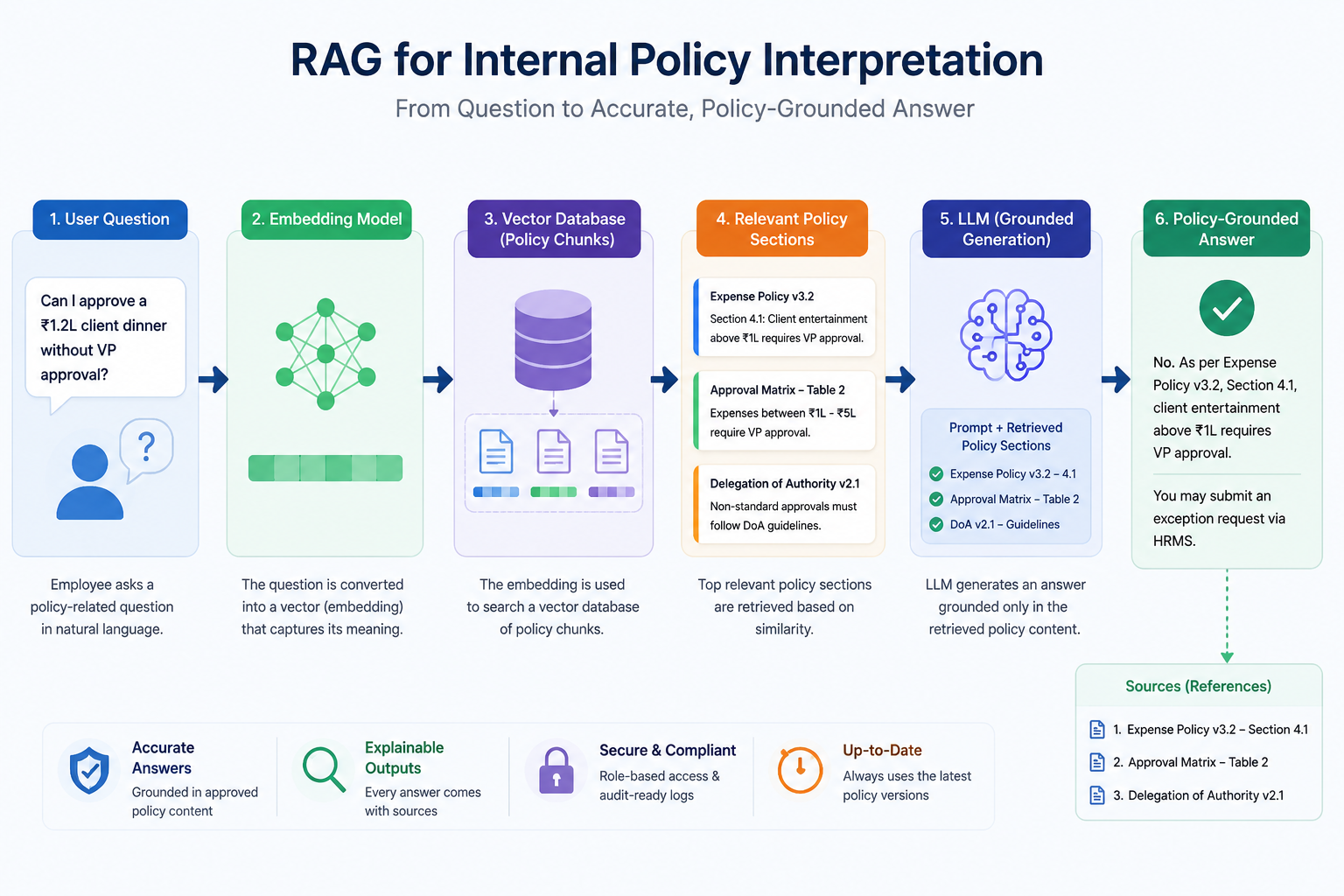
Key Design Decisions That Make or Break This System
1. Policy Chunking Strategy
Bad chunking = wrong answers
Best practice:
- Chunk by:
- Section
- Clause
- Sub-rule
- Preserve:
- Section titles
- Version numbers
- Effective dates
2. Version Control & Policy Supersession
Policies change frequently.
You must:
- Store version metadata
- Mark deprecated policies
- Prioritize latest effective versions
- Allow “as-of-date” queries
Example:
“What was the travel policy in March 2023?”
3. Role-Based Access Control (RBAC)
Not all employees should see all policies.
Examples:
- HR-only policies
- Leadership compensation rules
- Legal risk documents
RAG retrieval must respect:
- User role
- Department
- Geography
4. Answer Guardrails
Your system should:
- Reject questions outside scope
- Say “I don’t know” if no policy exists
- Never infer beyond retrieved text
This is enterprise-grade AI, not a demo chatbot.
Governance & Compliance Advantages
RAG systems can:
- Log every question and answer
- Store retrieved policy references
- Provide audit trails
- Support internal compliance reviews
This makes Legal and Compliance teams more comfortable, not threatened.
Measurable Business Impact
Typical Results Seen:
- ⏱️ 50–70% reduction in HR & Legal queries
- 📉 Fewer policy violations
- 💰 Lower compliance risk
- 📈 Faster decision-making
- 😊 Higher employee confidence
Why Most Companies Still Haven’t Built This
| Challenge | Reality |
|---|---|
| “Policies are messy” | RAG thrives on messy data |
| “AI may hallucinate” | RAG reduces hallucinations |
| “Too complex” | Architecture is stable & proven |
| “Legal won’t allow it” | Legal teams love grounded AI |
The real blocker is lack of execution clarity.
RAG vs Fine-Tuning (Quick Comparison)
| Aspect | RAG | Fine-Tuning |
|---|---|---|
| Policy updates | Instant | Retraining needed |
| Explainability | High | Low |
| Compliance | Strong | Weak |
| Cost | Lower long-term | High |
| Risk | Controlled | Hard to manage |
Who Should Build This First?
- Enterprises with 500+ employees
- BFSI, Healthcare, IT Services
- Highly regulated industries
- Companies with distributed teams
Final Thought: This Is the “Gateway RAG” Use Case
Internal policy interpretation is often:
- The first successful RAG deployment
- The trust-building AI use case
- The foundation for:
- Sales RAG
- Legal RAG
- Executive copilots
If done right, it unlocks company-wide AI adoption.
Want to Take This Further?
Next logical extensions:
- Policy risk detection
- Auto-flagging violations
- Decision simulations
- Compliance-ready reports
This is not just AI innovation —
it’s operational intelligence.